CAU-1
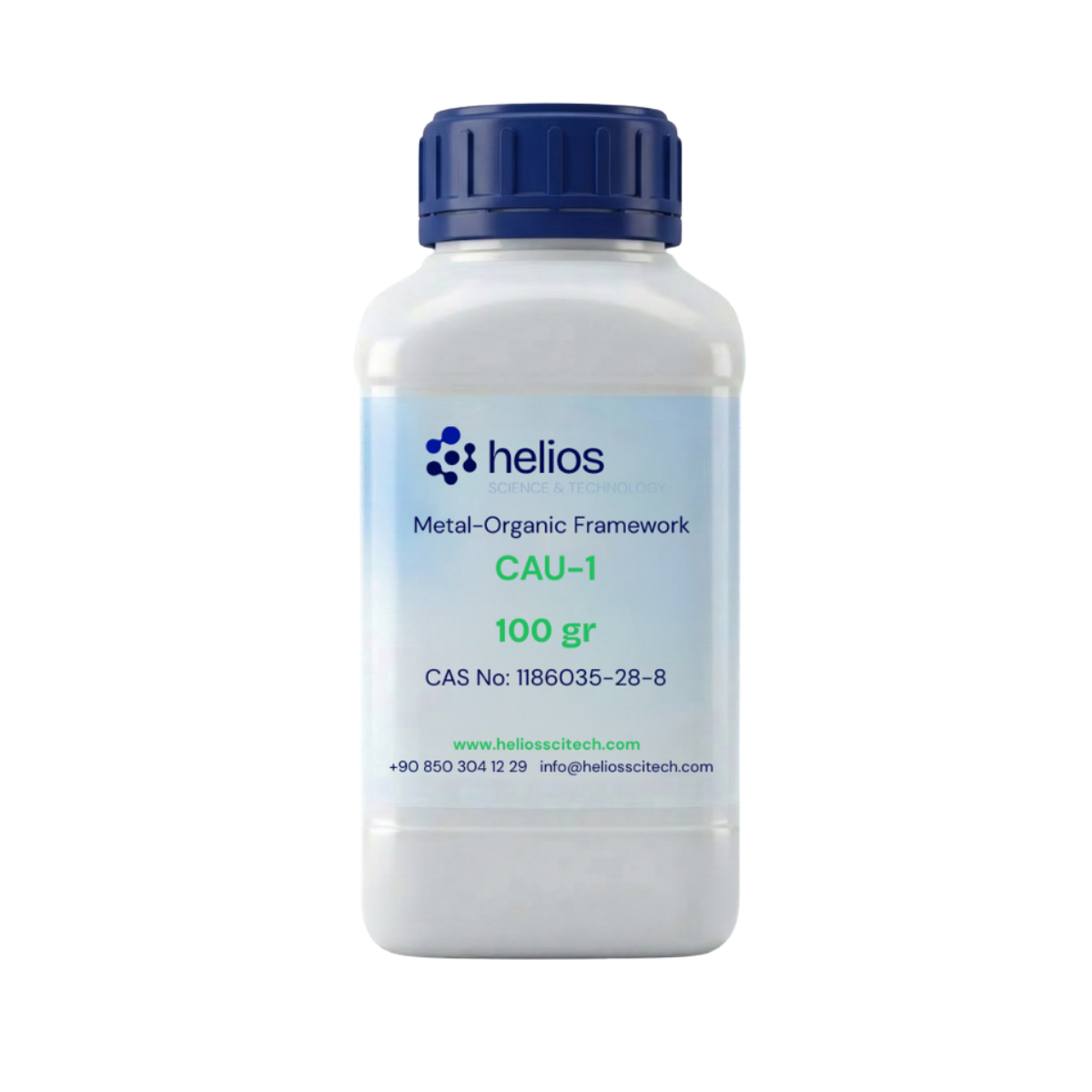
CAU-1 is an aluminum-based metal organic framework synthesized using 2-aminobenzene-1,4-dicarboxylic acid as the organic linker. The structure exhibits a highly porous architecture with large cage-like cavities and excellent chemical stability. The material demonstrates strong adsorption properties and high surface area, making it suitable for various advanced applications in gas separation, carbon capture, catalysis, and drug delivery systems. CAU-1 typically appears as a yellow crystalline powder with particle sizes ranging from 1–5 µm.
Application
Technical Specifications
Frequently asked questions
Quick answers about CAU-1. Can't find yours? Contact us
How do I activate CAU-1?
Commonly by exchanging the solvent with methanol and then heating under vacuum at around 150 °C for several hours. Use the conditions on the TDS for exact values.
Why does CAU-1 have amino groups, and why does that matter?
Its linker carries –NH₂ groups. They increase the affinity for CO₂ and allow post-synthetic modification, which is why CAU-1 is used in CO₂ adsorption and catalysis research.
What is CAU-1 typically used for?
CO₂ adsorption and separation, catalysis, post-synthetic functionalisation studies, and applications where an aluminium-based, low-toxicity MOF is preferred.
Can I order CAU-1 in larger quantities?
Packages up to 100 g can be ordered online. For larger or industrial quantities, contact us for a quote – we supply everything from gram-scale research samples to industrial batches.
Which countries do you ship to?
We ship within Türkiye and internationally, including Japan, South Korea, the United Kingdom, Spain, Belgium, Denmark, Canada, Australia and Brazil. The shipping cost is shown at checkout. If your country is not listed, contact us and we will arrange delivery.
Are SDS and TDS documents available for CAU-1?
Yes. The Safety Data Sheet (SDS) and Technical Data Sheet (TDS) can be downloaded from this page.
Can you synthesize a custom MOF for my application?
Yes. Tell us your target gas or application, the required particle size and quantity, and our R&D team will get back to you about custom synthesis.
Other Products
Advanced Zinc MOF Material
Our advanced zinc-based metal-organic framework (MOF) has a porous, crystalline structure with outstanding stability in humid, acidic, and steam-exposed environments. It generally appears as a white or off-white powder and delivers superior performance in industrial settings.
ZIF-8
ZIF-8 (Zeolitic Imidazolate Framework-8) is a zinc-based metal-organic framework synthesized via hydrothermal method using 2-methylimidazole as a linker. It features a sodalite topology with a high BET surface area of 1600–1800 m²/g and a pore size of 2.67 nm. ZIF-8 exhibits excellent thermal and chemical stability under ambient conditions, with well-defined rhombic dodecahedral crystal morphology. Its size-selective 3.4 Å aperture and structural flexibility make it a benchmark material for gas separation, hydrogen storage, catalysis, and drug delivery applications.
CPO-27 (Ni)
CPO-27(Ni) is a nickel-based metal-organic framework synthesized using 2,5-dihydroxybenzene-1,4-dicarboxylic acid (DHBDC) as the organic linker. This material is renowned for its honeycomb-like structure featuring a high density of open metal sites, which grant it exceptional adsorption capabilities. With a specific surface area of 800–1100 m²/g and a uniform pore size of 1.1 nm, it is a premier candidate for selective gas separation, carbon capture ($CO_2$ sequestration), and catalysis. It typically appears as a yellowish-brown solid powder with a particle size range of 0.5–3 µm.
Advanced Zinc MOF Material
Our advanced zinc-based metal-organic framework (MOF) has a porous, crystalline structure with outstanding stability in humid, acidic, and steam-exposed environments. It generally appears as a white or off-white powder and delivers superior performance in industrial settings.
ZIF-8
ZIF-8 (Zeolitic Imidazolate Framework-8) is a zinc-based metal-organic framework synthesized via hydrothermal method using 2-methylimidazole as a linker. It features a sodalite topology with a high BET surface area of 1600–1800 m²/g and a pore size of 2.67 nm. ZIF-8 exhibits excellent thermal and chemical stability under ambient conditions, with well-defined rhombic dodecahedral crystal morphology. Its size-selective 3.4 Å aperture and structural flexibility make it a benchmark material for gas separation, hydrogen storage, catalysis, and drug delivery applications.
CPO-27 (Ni)
CPO-27(Ni) is a nickel-based metal-organic framework synthesized using 2,5-dihydroxybenzene-1,4-dicarboxylic acid (DHBDC) as the organic linker. This material is renowned for its honeycomb-like structure featuring a high density of open metal sites, which grant it exceptional adsorption capabilities. With a specific surface area of 800–1100 m²/g and a uniform pore size of 1.1 nm, it is a premier candidate for selective gas separation, carbon capture ($CO_2$ sequestration), and catalysis. It typically appears as a yellowish-brown solid powder with a particle size range of 0.5–3 µm.