The 2025 Nobel Prize in Chemistry marked a historic moment for materials science. Awarded to Prof. Susumu Kitagawa, Prof. Richard Robson, and Prof. Omar Yaghi for their pioneering work on Metal–Organic Frameworks (MOFs), the prize recognized not only individual scientific achievement, but also the transformative potential of an entire class of materials.
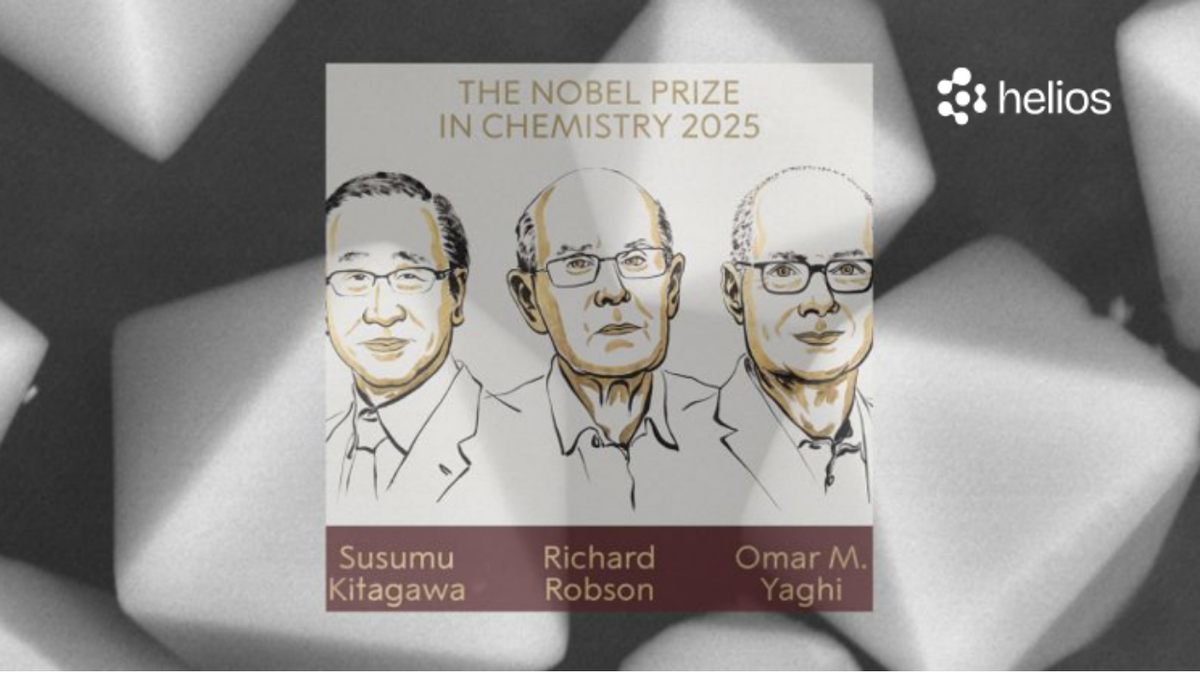
For decades, MOFs were regarded as an elegant scientific breakthrough—highly porous, tunable, and theoretically powerful. With this Nobel recognition, they have now been firmly established as a technology capable of reshaping how the world addresses pressing challenges such as climate change, energy efficiency, and industrial sustainability.
MOFs are formed by metal ions linked with organic molecules, creating sponge-like structures with extraordinary internal surface areas. A single gram can offer a surface comparable to several football fields, enabling highly selective interactions with gases. This unique property allows MOFs to capture CO₂ efficiently, store clean energy carriers such as hydrogen, and improve separation processes across industrial systems.
At HELIOS, this Nobel-recognized science is not an abstract achievement—it is the foundation of our daily work. We focus on translating MOF innovation into advanced sorbent materials designed for carbon capture directly from industrial flue gases. By targeting emissions at their source, HELIOS aims to support the decarbonization of hard-to-abate sectors such as steel, cement, and energy production.
The Nobel Committee’s decision sends a clear message: MOFs have moved beyond the laboratory and into a deployment era. The challenge ahead is no longer whether this technology will be used in industry, but how effectively and how quickly it can be scaled to meet global climate targets.
As HELIOS, we are proud to be part of this global innovation wave. Building on the scientific path opened by Nobel laureates, we continue our R&D efforts to turn MOF-based advanced materials into real-world climate solutions—solutions that can reduce emissions, improve industrial efficiency, and contribute to a more sustainable future.
What was once a scientific vision is now a Nobel-honored technology shaping tomorrow’s industrial standards. At HELIOS, we are committed to helping turn that future into reality.