A year ago, carbon capture in Türkiye was a distant topic for conference panels. Today it comes with a law, a timeline and a bill. As COP31 takes place in Antalya, Turkish industry is facing three dates, and all three point to the same place: the CO₂ in the stack.
Three dates that changed everything
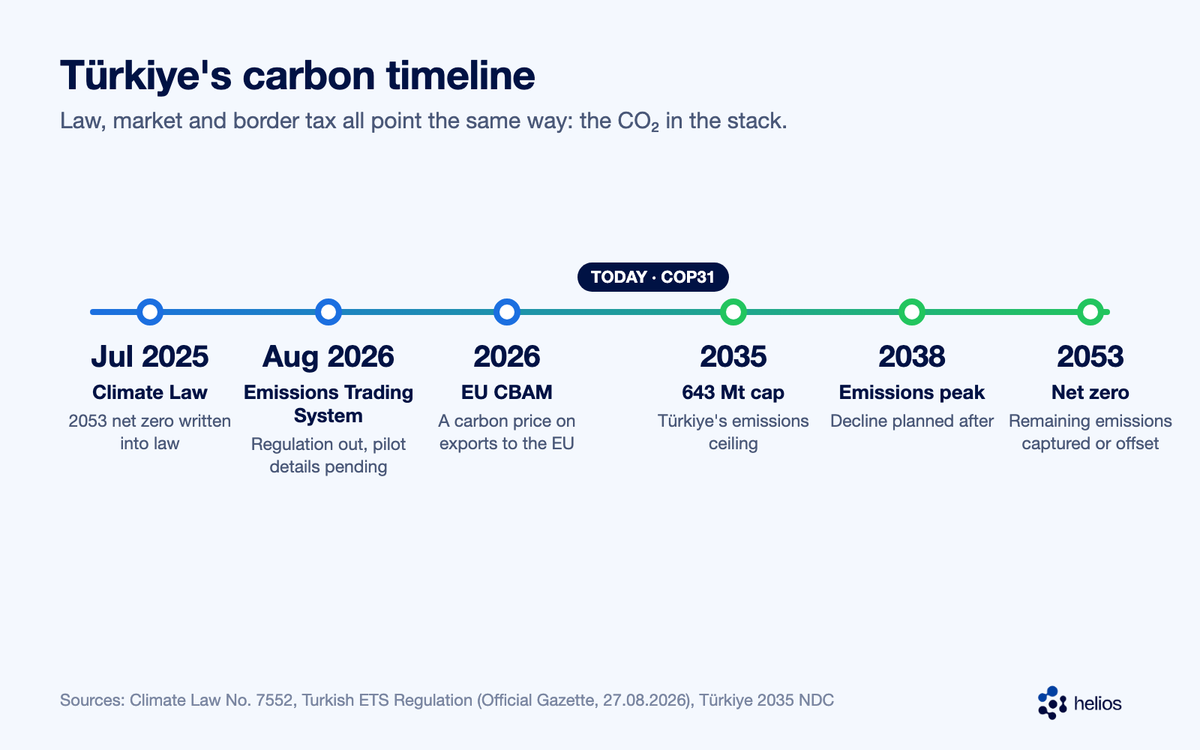
July 2025: the Climate Law. Türkiye's 2053 net-zero target is now written into law. The law requires large industrial facilities to obtain emission permits and report their emissions.
August 2026: the Emissions Trading System. Türkiye's ETS regulation was published in the Official Gazette and covers facilities emitting more than 50,000 tonnes of CO₂ a year. The first phase is planned as a pilot in which allowances are handed out for free. When the pilot starts and how it will work have not been finalised yet; details are expected during and after COP31. But the direction is clear: every tonne of CO₂ emitted will eventually carry a cost.
2026: the EU Carbon Border Adjustment Mechanism (CBAM). Exporters selling cement, steel, aluminium and fertiliser to the EU are starting to pay for the carbon in their products.
Why green energy alone isn't enough
Türkiye's 2035 target is to cap emissions at 643 million tonnes of CO₂ equivalent, peaking in 2038 and declining after that. Generating electricity from renewables is a big part of that path, but it doesn't solve everything in industry.
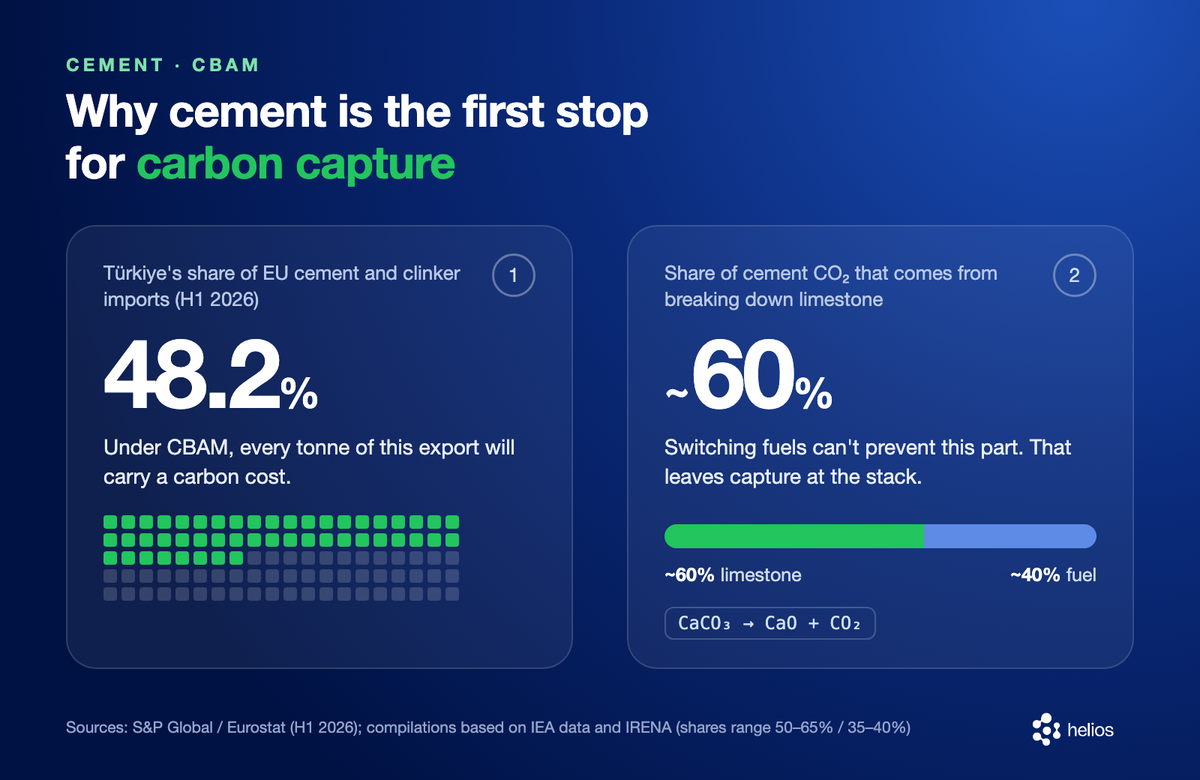
Take cement. A large share of its CO₂ doesn't come from fuel at all, but from limestone breaking down in the kiln. Even if you ran the kiln on solar power, that CO₂ would still be released. Steel, chemicals and waste-to-energy face similar problems. For these sectors, the realistic route is capturing CO₂ at the stack.
Cement matters especially for Türkiye. In the first half of 2026, Türkiye alone supplied almost half of the cement and clinker the EU imported from outside the bloc. That makes us one of the countries most exposed to CBAM.
Türkiye isn't new to this
At Batı Raman in Batman, Türkiye's largest oil field, TPAO has been injecting CO₂ underground since the 1980s. That CO₂ comes from a natural source rather than from industry, but it means there are decades of field experience in transporting, injecting and monitoring CO₂. The missing link is capturing CO₂ from industrial stacks at a reasonable cost.
The missing link: capture technology
Today's most common capture method uses amine solvents. They work, but they use a lot of heat to release the CO₂ again, and that drives up the cost of capture.
This is exactly the link we work on at HELIOS. Our MOFs are crystals with molecule-sized pores: they pick CO₂ out of the other gases in flue gas, release it with less energy, and can be reused again and again. And we make them in Türkiye, in Istanbul. For the basics of carbon capture, see Carbon Capture and Storage 101.
What should industry do now?
Once the ETS pilot starts, it will be a rehearsal for industry. Plants that already measure their emissions, know how much CO₂ each stack releases and are testing capture options will be ready when allowances start to cost money and the CBAM bill arrives.
If you'd like to discuss carbon capture for your plant, get in touch.
In our next post, after COP31, we'll look at carbon prices: what will a tonne of CO₂ cost in Türkiye?
Frequently asked questions
Does Türkiye have a carbon capture plant?
As far as we know, Türkiye doesn't yet have a commercial-scale plant capturing CO₂ from industrial stacks. CO₂ has been injected underground at the Batı Raman field since the 1980s, but that CO₂ comes from a natural source. With the Emissions Trading System and CBAM, the first industrial capture projects are expected to come onto the agenda in the coming years.
Who is covered by Türkiye's Emissions Trading System?
Under the regulation, facilities emitting more than 50,000 tonnes of CO₂ a year. They will have to monitor and report their emissions and surrender allowances equal to what they emit. The first phase is planned as a pilot with free allowances; its timeline and details are expected to be clarified after COP31.
How does CBAM affect Turkish exporters?
Companies selling cement, steel, aluminium, fertiliser, electricity and hydrogen to the EU pay for the carbon emitted in making their products. The cost rises with the carbon intensity of the product, so producers that cut their emissions pay less and gain an edge.
What are Türkiye's climate targets?
Net zero by 2053 (written into law by the Climate Law) and a 2035 cap of 643 million tonnes of CO₂ equivalent. Emissions are planned to peak in 2038 and then decline.
How can MOFs be used in Turkish industry?
MOFs are solid materials that selectively capture CO₂ from flue gas. In hard-to-abate sectors like cement, steel and chemicals, they have the potential to capture carbon with less energy than amine solvents. HELIOS makes these materials in Türkiye.