As the climate crisis continues to intensify, the need for technologies that can deliver measurable and scalable impact has never been more urgent. With global CO₂ emissions reaching record levels and hard-to-abate industries remaining among the largest contributors, platforms that connect climate innovation with global decision-makers play a critical role in accelerating change.
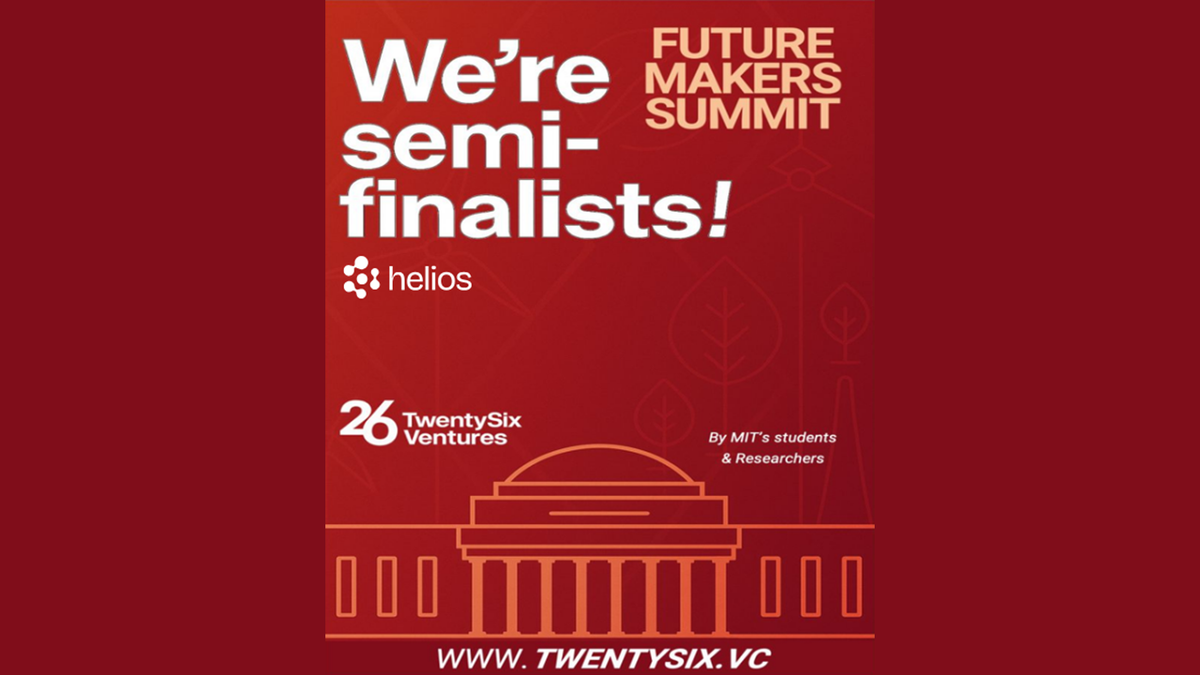
Organized by the Massachusetts Institute of Technology (MIT), the MIT FutureMakers Pitch Competition brings together early-stage and high-potential startups from around the world that are developing solutions across climate, energy, deep tech, and sustainability. Selected from hundreds of applications, participating ventures are given the opportunity to present their technologies to investors, academics, and industry leaders within a highly competitive and international environment.
Within this prestigious setting, HELIOS was selected in the Climate & Energy category and took the stage with its MOF-based CO₂ capture technology. Designed to address emissions directly at the source, HELIOS’s approach focuses on developing advanced sorbent materials that can support the decarbonization of energy-intensive industrial sectors.
Delivered in collaboration with Twenty Six Ventures, the MIT FutureMakers program goes beyond a traditional pitch competition. It provides startups with a framework to refine their technology vision, engage with the right stakeholders, and gain global visibility within the innovation ecosystem. The program culminates in the Grand Finals in New York, where selected ventures present their solutions on an international stage.
Participating in an initiative hosted by an institution such as MIT reflects HELIOS’s ambition to be more than a technology developer. It signals a commitment to contributing to global climate solutions through science-driven innovation and industrial applicability.
For HELIOS, the MIT FutureMakers Pitch Competition represents an important step forward in its journey toward enabling a cleaner, more sustainable industrial future—one where advanced materials play a central role in reducing emissions at scale.