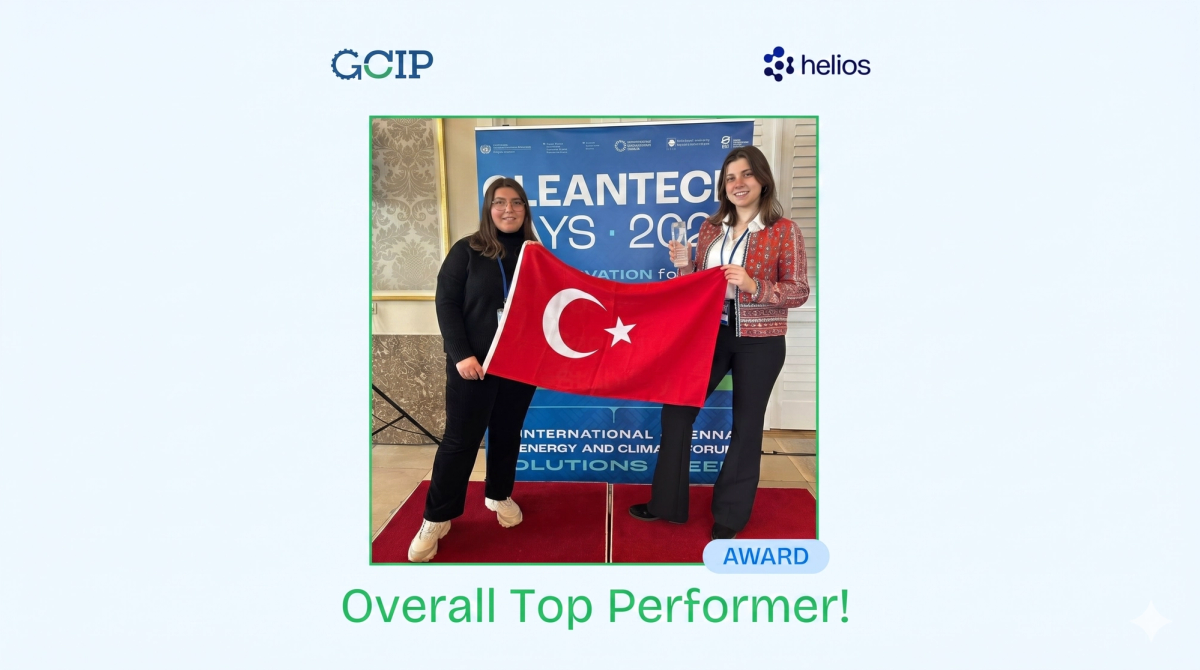
We've returned from Vienna with major news. At UNIDO Cleantech Days 2026, Helios was named Overall Top Performer in the "Emerging Startup" category — selected from dozens of cleantech ventures across 16 partner countries on four continents. It's a defining moment for us, and a meaningful one for Türkiye's deep-tech ecosystem.
What Exactly Is This Award?
UNIDO Cleantech Days is the annual global forum convened under the Global Cleantech Innovation Programme (GCIP) — the flagship initiative of the United Nations Industrial Development Organization (UNIDO). Established in 2014 by UNIDO and the Global Environment Facility (GEF), GCIP supports early-stage ventures and SMEs working on industrial decarbonization and the green industrial transition.
This year's edition was hosted at the Vienna International Centre and Hofburg Palace, bringing together leading cleantech entrepreneurs, climate investors, and policymakers from around the world. The "Emerging Startup" category is the most prestigious recognition available to early-stage ventures in this ecosystem. The international jury evaluates submissions on three criteria: technological innovation depth, global scalability, and verifiable environmental impact.
Helios competed with a dossier strong on all three, and won. The recognition validates that our MOF technology is not just a laboratory achievement — it's a commercially viable solution with global market relevance.
The 16 GCIP Partner Countries
GCIP operates across 16 partner countries on four continents. Türkiye is among the most mature partnerships in this network — GCIP-Türkiye has been hosted by TÜBİTAK (Scientific and Technological Research Council of Türkiye) since 2013.
Europe: 🇲🇩 Moldova, 🇺🇦 Ukraine, 🇹🇷 Türkiye
Asia: 🇰🇿 Kazakhstan, 🇲🇳 Mongolia, 🇵🇰 Pakistan, 🇻🇳 Viet Nam, 🇰🇭 Cambodia, 🇮🇩 Indonesia
Africa: 🇲🇦 Morocco, 🇸🇳 Senegal, 🇳🇬 Nigeria, 🇳🇦 Namibia, 🇱🇸 Lesotho, 🇿🇦 South Africa
Latin America: 🇺🇾 Uruguay
Reaching the top of this 16-country network signals that Türkiye's cleantech ecosystem can compete on equal footing with mature ecosystems in Berlin, Singapore, and Silicon Valley.
The Technology Behind the Award: MOFs
Helios specializes in Metal-Organic Frameworks (MOFs) — crystalline porous materials made from metal ions and organic linkers. A single gram of MOF can have a surface area equivalent to a football field, making them exceptional tools for gas adsorption.
What does this mean in practice? We're talking about materials that can selectively capture CO₂ from flue gas streams in high-emission industries like cement, steel, and aluminum. Compared to conventional amine-based solutions, MOFs operate with lower regeneration energy, longer service life, and smaller plant footprints.
Today, Helios produces 8 commercial MOF types at scale and exports to 7 countries. Our anchor customer relationship with Çimko (Sanko Holding), one of Türkiye's leading cement producers, anchors our commercial validation. Our R&D infrastructure spans dual locations at Boğaziçi University Kandilli Deep Tech Hub and Teknopark Istanbul, complemented by a strategic European presence at TU Munich.
From Lab to Industry: Scalable Manufacturing
The challenge that derails most cleantech ventures is the so-called "valley of death" — the gap between laboratory success and industrial-scale deployment. The MOF world is no exception. Most MOFs can be synthesized at gram scale, but scaling to kilograms or tons is where most efforts stall.
This is precisely where Helios stands out — and a key reason behind our recognition. Our high-shear-mixer-based manufacturing process enables MOF production at industrial scale with high reproducibility and reduced solvent consumption. That makes a critical difference on both cost and environmental footprint.
Our target: becoming a strategic supplier for 1,000 TPD (tons-per-day) commercial carbon capture systems. A single system at this scale requires thousands of tons of MOF sorbent per year. Considering the number of facilities the sector will deploy over the next decade, this represents a substantial growth opportunity for Helios.
The European Market, MENA, and the CBAM Effect
Vienna is not a destination — it's a strategic gateway. Our near-term focus spans two adjacent markets: the DACH region (Germany, Austria, Switzerland) and Central-Eastern Europe (CEE) on the European side, and the MENA region — particularly the Gulf and North Africa — where cement, steel, and petrochemical sectors are entering their own decarbonization phase.
European producers are under intense pressure from the EU Carbon Border Adjustment Mechanism (CBAM). CBAM imposes carbon costs on imported goods based on their embedded emissions, while EU producers face rapidly rising costs under the EU ETS. MENA exporters selling into the EU face the same CBAM exposure on their shipments — making carbon capture a commercial necessity, not just an environmental ambition. In this equation, MOF-based carbon capture offers a competitive alternative to conventional amine systems on a cost-per-ton basis.
We deliver this not just as a product sale, but through a MOF-as-a-Service model: customers receive sorbent supply, performance guarantees, and renewal services across a 5-year lifecycle. Recurring revenue for us; reduced operational risk for the customer.
Investment, Ecosystem, and What's Next
This achievement didn't happen overnight. TÜBİTAK-funded R&D, our Boğaziçi University collaboration, and the Teknopark Istanbul ecosystem laid the foundation that's moving us from TRL 4 to TRL 6-7. A decade of work by GCIP-Türkiye has built the invisible institutional infrastructure behind this international success.
Our priorities for the next 18 months are clear:
Transitioning our industrial-scale manufacturing process from pilot to commercial line
Deepening existing customer relationships in Türkiye and expanding into adjacent industrial sectors
First pilot deployments and reference customers across DACH and MENA
Expanding our product portfolio with new MOF types
Closing strategic investor partnerships to fund growth
A Bridge Between Europe and MENA
The deeper significance of this award is geographic as much as technological. Helios sits at a strategic crossroads — close enough to serve Europe's industrial heartland, and well-positioned to scale into the MENA region, where cement, steel, and petrochemical industries face their own decarbonization deadlines.
For European producers, we offer a near-shore manufacturing partner with shorter lead times and lower logistics emissions than transatlantic competitors. For MENA industries, we offer a partner that understands the operational realities of cement and steel production in the region, with infrastructure ready to support deployment.
UNIDO Cleantech Days 2026 confirmed that we're not just one of many cleantech startups — we're a credible bridge between two of the world's most important industrial decarbonization markets.
We're building a cleaner, more prosperous industrial future — through innovation, together.