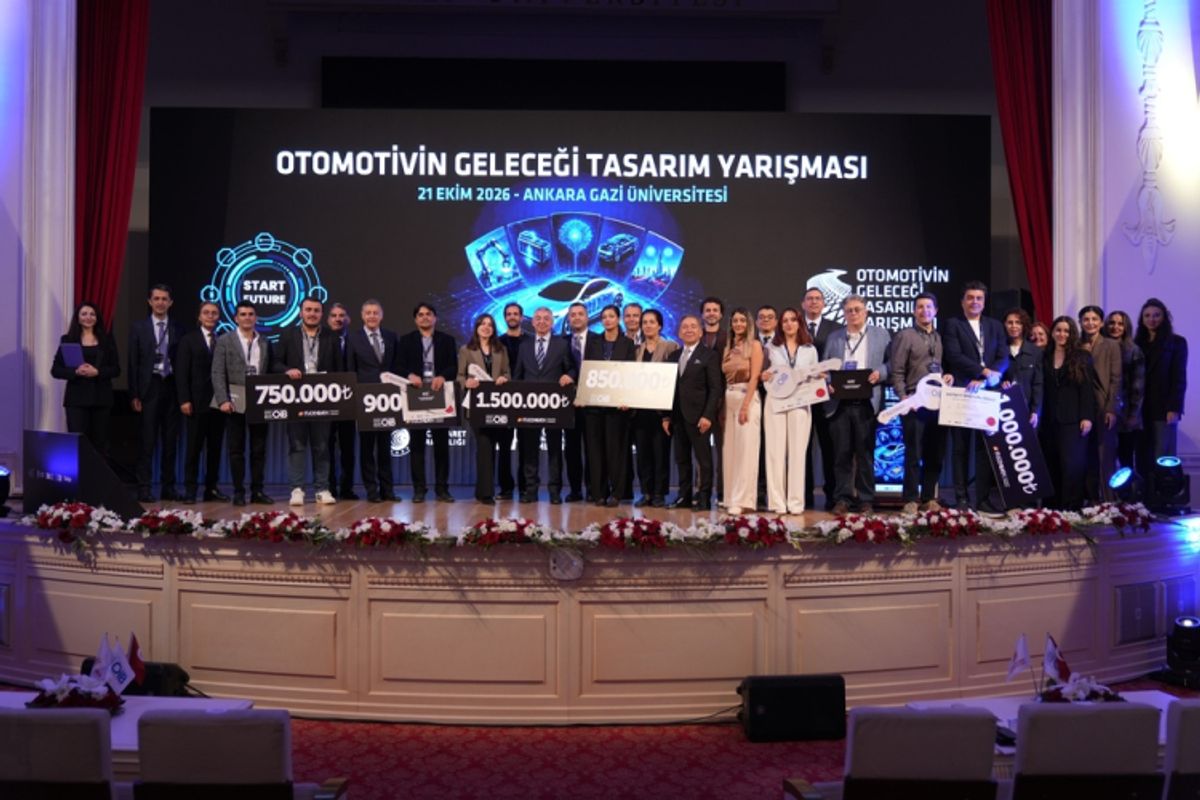
435 projects applied, 10 made the final, and HELIOS came first. We won the 15th Future of Automotive Design Competition (OGTY), organised by the Automotive Industry Exporters' Association (OİB), at the award ceremony at Gazi University in Ankara on 21 October 2026. The prize is 1.5 million Turkish lira. The winning project uses MOFs to store hydrogen in vehicles at lower pressure, more safely and more compactly. Behind it are our Founder & CEO Gizem Uysal and our Co-founder & COO Gizem Şanyılmaz.
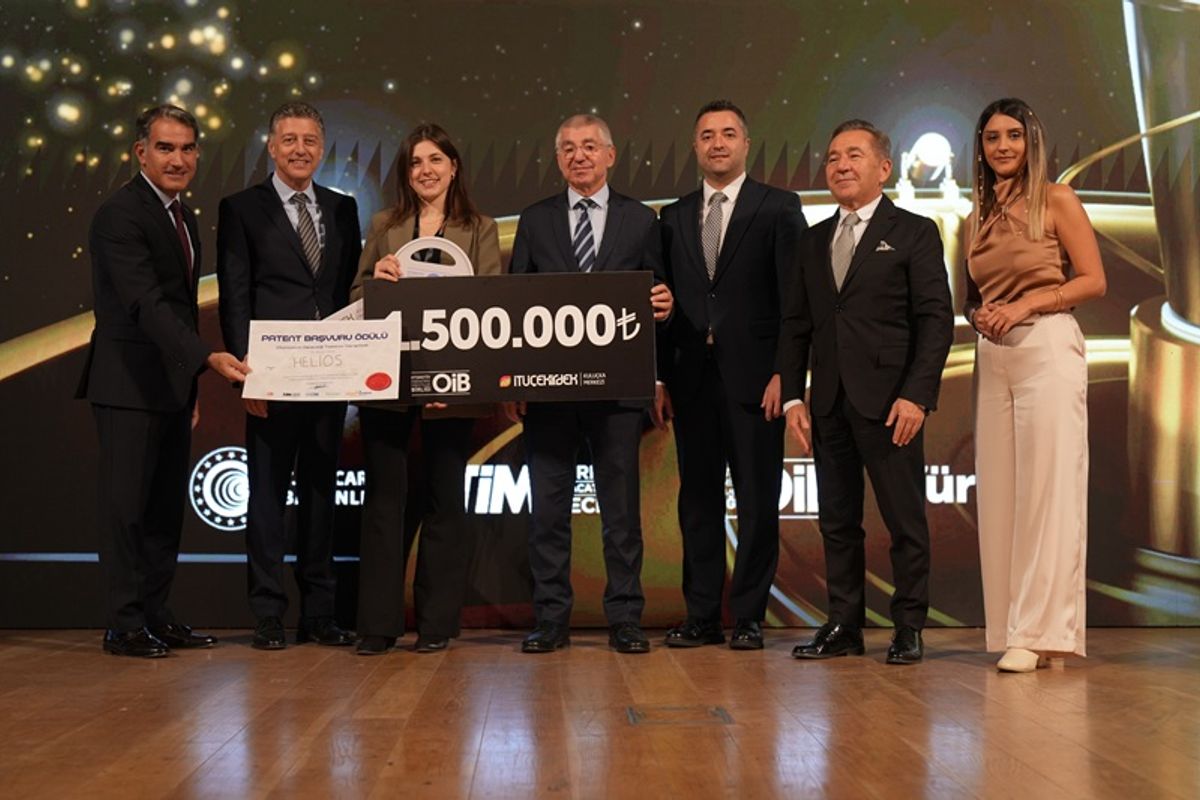
The award ceremony
The ceremony was hosted by OİB Chairman Kemal Yazıcı and OGTY Executive Board Chairman Zeki Şafak Ozan. Also attending were Mehmet Ali Kılıçkaya, Director General of Exports at the Ministry of Trade; Prof. Dr. Serhat Karyeyen, Vice Rector of Gazi University; Prof. Dr. Cafer Çiftçi, Vice Rector of Bursa Uludağ University; and Prof. Dr. Attila Dikbaş, General Manager of İTÜ ARI Teknokent. Dr. Elif Altuğ, General Manager of the Türkiye Development Fund, presented the OİBventure Mobility Innovation Fund.
OİB has run OGTY since 2012 with the support of the Ministry of Trade and the coordination of the Turkish Exporters Assembly (TİM), making it one of Türkiye's longest-running automotive innovation competitions. This year's theme was "Industrial Mobility". Besides 5 million lira in cash prizes, the top five projects received a patent application award and the İTÜ Çekirdek Growth award.
Hydrogen vehicles are ready to go. What about storage?
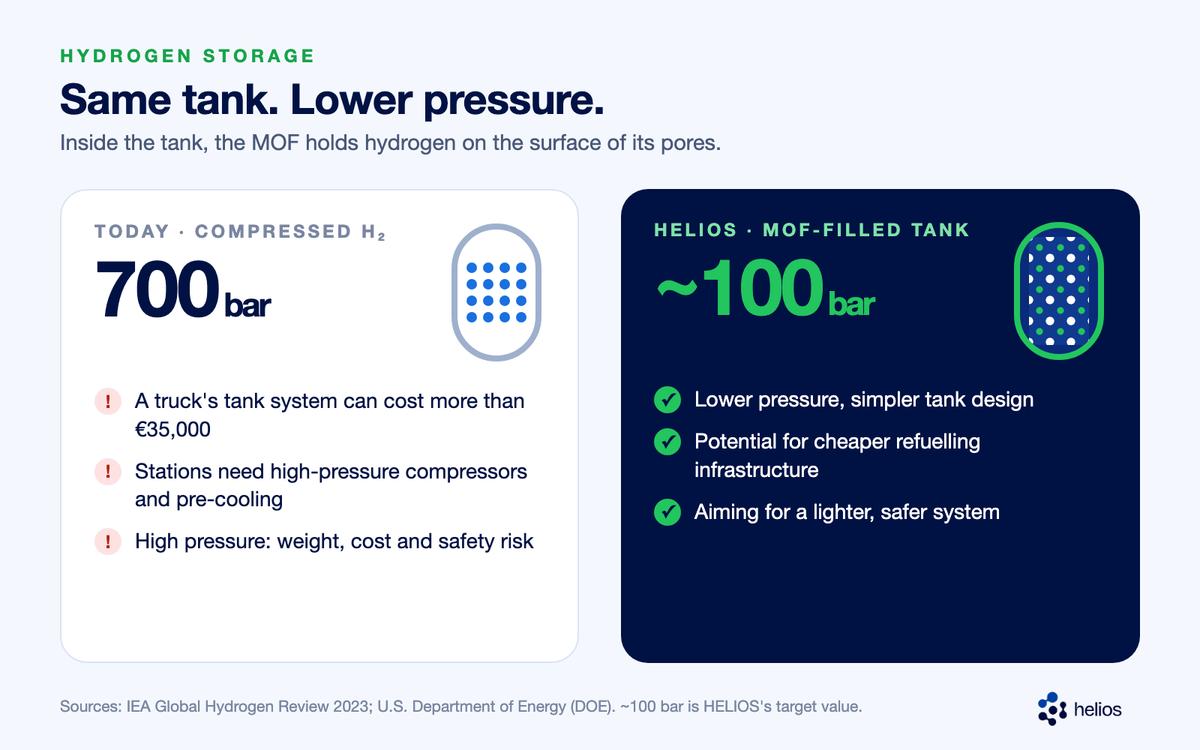
Hydrogen is one of the strongest ways to decarbonise heavy transport such as trucks and buses. But today vehicles store it either as a gas at 700 bar or as a liquid at −253 °C. A truck's tank system can cost more than €35,000, and refuelling stations need high-pressure compressors and pre-cooling. The fuel is clean; storing it is expensive.
Our solution: same tank, lower pressure with MOFs
MOFs (metal-organic frameworks) are porous crystals with a huge internal surface area. When the tank is filled with MOF, hydrogen sticks to the surface of its pores, so the same hydrogen can be stored at a much lower pressure. Our target is around 100 bar instead of 700: a simpler tank, cheaper refuelling infrastructure and a lighter, safer system.
Four properties make MOFs strong for this job: high storage capacity, chemically tunable pores, a modular structure and low energy demand. That is why we are designing our solution as MOF-filled cartridges that can be integrated directly into vehicles.
Why now?
By 2030 the EU requires a hydrogen refuelling station every 200 km on its main corridors, and 90% of new city buses must be zero-emission. According to OİB data, 74% of Türkiye's automotive exports go to the EU, so these rules directly affect Turkish suppliers. Hydrogen vehicles are coming, and storage has to keep pace.
Carbon capture is our core business, and our MOFs work in hydrogen too
HELIOS focuses on carbon capture: we develop and produce MOFs that pick CO₂ out of flue gas. Winning OGTY showed that the same materials platform has a strong role in hydrogen storage too. The strength of MOFs is that their pores can be tuned to the target gas: one design selectively holds CO₂, another packs hydrogen densely inside a tank.
For the basics of carbon capture, read Carbon Capture and Storage 101; for the latest in Türkiye, see Carbon Capture in Türkiye: The Clock Is Ticking; and for MOFs in gas storage, visit our gas storage page.
Thank you
We thank OİB, the Ministry of Trade and TİM for running this competition year after year, and we congratulate our fellow finalists ICARBON, Gibrin eDrive, NuManufacturing and TUSMEC. Earlier this year we won three awards at the GCIP Türkiye finals; winning OGTY is another milestone of the year.
Frequently asked questions
What is the Future of Automotive Design Competition (OGTY)?
The Future of Automotive Design Competition (OGTY) has been run since 2012 by the Automotive Industry Exporters' Association (OİB) to reward innovative ideas and startups in automotive and mobility. It is supported by the Ministry of Trade, coordinated by the Turkish Exporters Assembly (TİM), and has received more than 6,000 applications so far.
The 15th edition in 2026 had the theme "Industrial Mobility". Out of 435 applications, 10 projects reached the final and HELIOS took first place.
Which project won OGTY 2026 for HELIOS?
Our project to store hydrogen in vehicles at lower pressure, more safely and more compactly, using MOF-filled cartridges. It competed in the alternative fuel technologies, materials and components, and eco-friendly vehicles field.
Besides the 1.5 million lira first prize, we also received the patent application award and the İTÜ Çekirdek Growth award given to the top five projects.
Why is hydrogen storage so hard in vehicles?
Hydrogen carries a lot of energy per kilogram but is extremely light. To give a vehicle enough range, it is either compressed to around 700 bar or cooled to −253 °C and liquefied.
High pressure means thick-walled, heavy and expensive tanks; a truck's tank system can cost more than €35,000. Liquid hydrogen needs constant cooling and loses some fuel to boil-off. Refuelling stations also need high-pressure compressors and pre-cooling, which makes the infrastructure expensive.
How do MOFs store hydrogen?
MOFs (metal-organic frameworks) are crystals built from metal nodes joined by organic linkers, full of molecule-sized pores. A single gram of MOF can have an internal surface area of thousands of square metres.
When a tank is filled with MOF, hydrogen molecules stick physically to the surface of these pores (adsorption), so more hydrogen fits in the same volume than in an empty tank. Lowering the pressure or warming the tank slightly releases the hydrogen again, and the same MOF can be reused many times.
What is the advantage over 700-bar tanks?
The main advantage is storing the same hydrogen at a much lower pressure: our target is around 100 bar instead of 700.
Lower pressure means thinner-walled, lighter tanks, simpler and cheaper refuelling stations, less compression energy and lower safety risk. Thanks to the cartridge design, the system is modular and can be scaled for trucks, buses and other vehicle types.
Which MOFs are used for hydrogen storage?
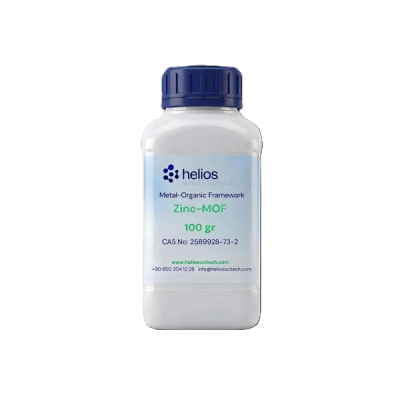
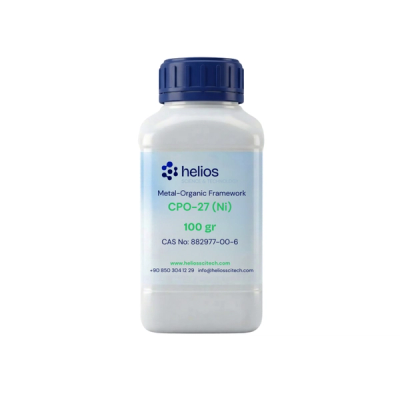
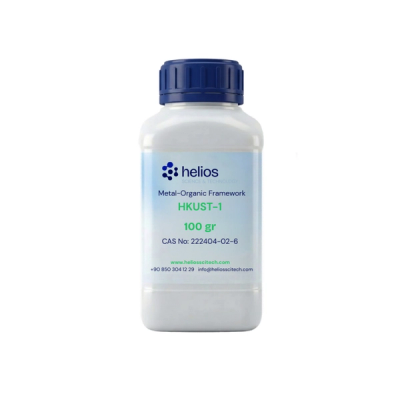
Among the most studied MOFs for hydrogen storage are MOF-5, MOF-177, HKUST-1, ZIF-8 and the MOF-74 family. HKUST-1 (Cu-BTC) stands out for its high surface area and open copper sites, ZIF-8 for its chemical and thermal stability, and CPO-27 (Ni), a member of the MOF-74 family, for open nickel sites that bind hydrogen strongly.
We offer all three in different package sizes for research and development in our MOF store.
Can MOFs store hydrogen at room temperature?
In MOFs, hydrogen is held by physical adsorption, which is strongest at low temperatures; that is why the highest capacities are usually measured at around −196 °C (77 K).
To raise room-temperature capacity, a lot of research focuses on MOFs with open metal sites that hold hydrogen more tightly, such as CPO-27 (Ni), and on pore chemistry. Our approach is to design the MOF together with the system, as a cartridge, to lower the storage pressure.
What is HELIOS's main field?
Our main field is carbon capture. We develop and produce MOFs that selectively capture CO₂ from flue gas and release it with less energy, for hard-to-abate sectors such as cement, steel, chemicals and energy.
Among our materials for CO₂ capture are CPO-27 (Ni) and HKUST-1. Hydrogen storage is the second major application of the same MOF platform. You can browse all our materials in the MOF store.